
A BRIEF HISTORY OF
ST. MARK’S EV. LUTHERAN CHURCH,
THE PIONEER CHURCH OF LUTHERANISM IN THIS CITY
1852 TO 1896.
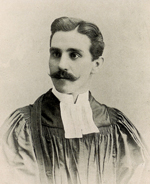
BY THE PASTOR, WILLIAM F. RICK.
PREFACE.
 Though
Solomon complained, “Of making many books there is no end,” we offer no
apology for our booklet. God’s Israel need never apologize when they ask
the world to listen to the story of His dealings with them. That there
are numberless congregations does not detract from the glory of their
God-begotten purpose, nor the profit to be gained by a perusal of their
deeds. Their successes should be the shout of victory on the field of
battle, which, running along the line, inspires the whole army to still
greater conquests; their failure, the sound of the buoy-bell warning of
dangerous shoals.
Though
Solomon complained, “Of making many books there is no end,” we offer no
apology for our booklet. God’s Israel need never apologize when they ask
the world to listen to the story of His dealings with them. That there
are numberless congregations does not detract from the glory of their
God-begotten purpose, nor the profit to be gained by a perusal of their
deeds. Their successes should be the shout of victory on the field of
battle, which, running along the line, inspires the whole army to still
greater conquests; their failure, the sound of the buoy-bell warning of
dangerous shoals.
We regret, however, the form in which we have presented the record. The hungry cry of the printer for copy has prevented that literary polish we would like to have given. We have not been able to rescue as much from the deluge of the past as we wish. No vestige of the missionary and charitable contributions, of the formation of the Sunday School and Young People’s Association remains. We have gained most of our information as the reporter gains his, the ‘‘Church Records’’ of the most important periods being lost. If we have erred, then, in a few details or failed to record others, we wash our hands of the charge of willful transgression. Some may object to the many advertisements. We thank the advertisers, and would say to those objecting that these are the financial wings upon which our bird has mounted, and if you do not like them you should have informed us and we would gladly have allowed you to provide, from your own purse, others more beautiful.
And now, with greater love for our dear St. Mark’s, and a higher hope for her than when we began, we lay down the historian’s pen, which we hope a more gifted writer will pick up at some future time to write a more glorious history.
THE AUTHOR.
BRIEF HISTORY OF ST. MARK’S.
“I love Thy Zion, Lord,
The House of Thine abode;
The Church our blest Redeemer saved
With His own precious blood.”
Remember the days of old.”—Deut. 32: 7.
“Write this for a memorial in a book, and rehearse it.”—Ex.
17: 14.
“He commanded to bring the book of records.”—Esther 6: 1.
‘‘Walk about Zion and go around about her. Tell the towers
thereof. Mark ye well her bulwarks; that ye may tell it to
the generations following.”—Ps. 48: 11.
WILLIAMSPORT FIFTY YEARS AGO.
Picture to yourself Williamsport, not as she is to-day, a populous, thriving city with well paved streets, beautiful homes, substantial business blocks, handsome churches and schools, and around about such unrivaled pleasure drives as Vallamont and Grampian but as she was in 1852, a little country town. Third Street, beginning at Penn and ending at Hepburn, was the business centre, where, in the general stores, anything might be purchased or had in exchange for butter and eggs from a hair pin or a jug of molasses to a pair of spiked boots or an Easter bonnet. Fourth Street boasted nothing more pretentious than plain one and two-story houses, and beginning at Academy Street was a country road at the spot where the First Baptist Church now stands; while where is now the Elliot mansion might be heard at night the deep basso profundo vesper hymn of the frog, or in the morning he could be seen diving into the green-coated pond just in time to escape the small boy anxious to bear him home in his tin can as a trophy of his prowess. On Market Street there still stood a log house. The slightest rain transformed the road into a muddy sea, in which teamsters could exercise their patience as they yelled at and whipped their horses into pulling their wagons sunk into the mud almost to the axle. A canal was crossed at Canal Street by a swing bridge when no boats impeded progress, and the river was spanned by a wooden bridge enclosed overhead and on either side so effectually as to cause perpetual semidarkness and shut out the glorious view. Add to this description a few scattered houses on the South Side; in place of “Newtown’’ see waving fields of grain and virgin woods, and we have a. picture of the Williamsport of our fathers.
EARLY LUTHERANS.
But small as was the town, even ere this it had within it those who were true to the great doctrines of the Mother Church of Protestantism—doctrines that have been watered with the blood of martyrs; doctrines of which St. Paul had said though an angel from the Heaven proclaims any other let him be accursed. These early Lutherans from the “Fatherland” worshiped with the Reformed in a little square one-story gray stone church, in appearance quite like the Evangelical Church on Market Street, near the Pennsylvania Railroad. It occupied the same site as that of the German Reformed Church on Third Street, recently sold. But as the years went by it became evident that the Church was greater than the language, great and grand as was that dear mother tongue. And as the early Christian Church had found it necessary to burst her Palestine moulds, so these Lutherans needs burst their German mould. Accordingly on March 7, 1852. Rev. Dr. H. Ziegler organized the
FIRST ENGLISH LUTHERAN CONGREGATION.
The first officers were:
Elders: Jacob Weis and Lewis Lutcher.
Deacons: Adam Felker and George Hantranft.
Trustees: Jacob Weis, Henry Weigel and Peter Alt.
We can imagine something of the solemnity of the
FIRST COMMUNION
administered by Rev. Ziegler, April 5th, in the little old German Church. How impressive sound those words of the institution as they fall from the pastor’s lips for the first time in our native tongue: “Our Lord Jesus in the night in which He was betrayed took bread and when He had given thanks, He brake it and gave it to His disciples, saying, Take, eat; this is my body which is broken for you; this do in remembrance of Me. After the same manner He took the cup, and when He had given thanks, He gave it to them, saying, Drink ye all of it; this cup is the New Testament in my blood, which is shed for you and for many for the remission of sins.” With what feelings the little flock come forward to the altar to receive that precious body and blood, which had been broken for them! How their hearts burn within them as they hear the minister say: “The body of our Lord Jesus and His precious blood strengthen and preserve you in the true faith!” They are lifting high the banner of their loved Church; will they be able to hold it aloof in the thick of his new battle they are to wage against sin in this community? There are many discouragements to be met; will this Communion really strengthen them for them? They are the possessors of a great truth “once delivered unto the Saints;” but would people regard them as such, or as merely another “sect ?” They are few; but so were the disciples among whom this blessed sacrament was instituted. They might have wavering ones and betrayers; so had the twelve. And then comes the benediction, stilling all doubts, ringing out like the soft chimes of another world: “And now may the peace of God which passeth all understanding keep your heart and minds through Christ Jesus unto everlasting life.” Ah, methinks there must have been many tears glistening in the eyes and fervent, though silent, prayers that the Almighty saw and heard at that first Communion.
We have still the names of those who partook of that holy feast. They are:
Mr. A. H. Stahl, Catharine A. Stahl, Elizabeth J. Kratzer, Daniel Kleckner, Susannah Kleckner, Christina Shumaker, John Habey, Jacob Weis, Mrs. Mary Weis, Miss Mary Weis, Miss Catharine Weis, Henry Weis, Henry Weigel, Mrs. Amelia Weigel, Miss Susannah Weigel, Martin Ellinger, Mrs. Mary A. Ellinger, Adam Felker, Mary C. Felker, Julia Ann Rickart, Sophia Rickart, Henry Rickart, Mrs. Christiann Rickart, Henry Ziegler, pastor; Mrs. Eliza Ziegler, Rosanna Lutscher, Mary Lutscher, Susan Frey, Mrs. Elizabeth Fruth, Mrs. Mary Ann Ritter, Mrs. Charlotte Coder, Mrs. Euphemia Geiger, Mrs. Catharine Peterman, Thomas Turk, Mrs. Henrietta Turk, Andrew Esslinger, Peter Alt, Mrs. Charlotte Plankenhorn, Mrs. Rebecca Ulrich, Mrs. Sarah Lence, Mary Kuhns, George Hartranft.
But it was not until December 31st of that year that the congregation was fairly launched; a charter being then granted. Overtures were made to the German Lutherans to secure their co-operation in the erection of a common house of worship, but failed. A lot on Market Street, which a few months later was exchanged for the present site, had already been purchased for $425.00. Of this amount $286 was paid by
THE FEMALE INDUSTRIAL SOCIETY.
We smile at the name; but “as a rose by any other name would smell as sweet,’’ o this noble band of women, as the church records often testify, did more than many another society with a much better name. In truth we may say had it not been for their efforts, upon more than one occasion the congregation would have been wrecked upon financial shoals. All honor to them. They had caught the spirit of those women who were the last at the Cross and the first at the Tomb, of Dorcas who cared for the poor, of Lydia whose labors were for the early Church, of Phoebe who delivered Paul’s wonderful Epistle to the Romans, of Eunice and Lois who bound the great preacher’s wounds. And their labors were doubtless as acceptable to Christ as was Martha’s, who, breaking the costly box of ointment and pouring it upon His feet, wiping then with her hair, received the commendation : “She hath done all she could.”
April 3d, 1853, found the congregation still worshiping in the old German Church but without a pastor. Rev. Dr. H. Ziegler having resigned to subsequently become a theological professor of the Missionary Institute at Selinsgrove.
REV. JOS. WELKER COMES FROM CLARION COUNTY IN A COVERED WAGON
The town was not yet touched by railroads. Travel was done by canal boat, stage or covered wagons. It was in one of the latter that the pastor elect came over the mountains and landed with his wife and children in the midst of his little flock, on the first day after the celebration of Independence Day, 1853. The reception he received stung deeply his sensitive nature; for protests were raised by some malcontents against his occupancy of the parsonage; although as his eyes rested upon the garden, carefully planted by loving hands for his delight, he was cheered with the thought that not all were hostile to his coming. None but those who have had experience know the discouragements of missionary work. Thirty members were all that the young congregation could claim. There had been talk of building a. new church; for “coming events always cast their shadow before.” But between talking of building a church and building one there is a high fence to climb that needs considerable “boosting.” But Nehemiah had come for the upbuilding of the walls of Zion. And “full of the Holy Ghost and of power,” he at once addressed himself to this work. A building committee of two was appointed. Although for all concerned, it might, have been one and that one the pastor. He himself has left record that he made all contracts, hired all laborers, paid all bills; yea, such was his zeal and devotion that he labored with his own hands digging in the cellar, laying brick and aiding in the carpenter work. So rapidly was the work pushed that a little more than a year after his arrival the
CORNER STONE WAS LAID, OCTOBER 7, 1854.
The past has left no record of this interesting event save that Bishop Bowman, then President of Dickinson Seminary, aided in the celebration; while in the after service, held in the Second Presbyterian Church, Rev. Winecoff, of Lewisburg, preached the sermon. The dedication occurred January 22, 1856. We insert this record of the treasurer on that day:
CR.
Subscriptions paid in, . . .
$2,000.00
Reliable subscriptions, . . .
100.00
‘‘Subscriptions from abroad,’’ . 1,200.00
Collection, night of dedication, . . 700.00
Total, . .
. . . . .
. $4,000.00
DR.
Cost of church, . . . . . . $4,000.00
AN AMUSING INCIDENT.
Grateful for the work that had been done and afraid of being tempted to say, like Nebuchadnezzar, as they viewed their church, then considered one of the finest in the city, “Behold, is not this great Babylon which I have built?” our fathers caused a white marble slab to be placed in the front wall and inscribed with the legend: “Hitherto hath the Lord helped us.” Imagine their consternation one morning to find beneath it in clear bold letters an addition, made by mischievous boys, “but hereafter we shall help ourselves.”
THE OLD BELL.
We sometimes criticise its tone; but dear old bell, it tells a tale of sacrifice greater than many of us have made. Over many a rough mountain road its donor, the pastor, tramped to lecture in a “skule” house, plead before some well-to-do congregation, or petition a wealthy farmer for funds, “all tending,” to use the pet phrase of the church secretary of those days. “to the same grand end,” the procuring of a bell to waken sleepy sinners. Ring on, old bell! ring on! and as thou hast rung these forty years, ring for forty score ye more, until our children’s children’s children, one and all, have wakened from their sins.
DARK DAYS.
But even the new church did not secure golden success for our little band, eager to make the precious gospel of the great Reformer a savor unto life in this community. Some thought them “too Methidistic.” and some “not Methodistic enough.” Some declared the pastor “too progressive,” others “not progressive enough.’’ We quote his own words: “The minister’s salary has always been secured only with great difficulty. At times, how to live was a matter of great distress. We have been almost miraculously aided, else we could not have been here until now. The people of our charge are for the most part poor.” And then again he writes: “We are leading a distracted, disappointed and wretched life in the old parsonage.” One day, however, a gleam of joy fell upon his pathway, just as the clouds were most threatening. It was
A DONATION PARTY
that brought the good things of life into the empty larder and was valued by the poor, struggling missionary at the princely sum of $210. Under God, he piously remarks, this donation party was a great thing for our congregation. Of course, it was, since not even a minister of God’s everlasting gospel can live without enough to eat. Thirty new members joined shortly after, the result of a special season of prayer. This made a congregation of some seventy souls, when Rev. Welker resigned and was followed by
REV. J. F. FAHS.
It was common at this time for young men destined for the ministry, instead of going to a theological seminary, to complete their education under some pastor. Around the dominie of their choice they would gather, in numbers from one to six. Sometimes they even lived with him, gaining experience by acting as a sort of assistant. It was at the feet of a no less distinguished divine than the Rev. Dr. Joseph Seiss, LL. D., whose influence on the American pulpit will always be felt and some of whose books have been translated into fourteen different languages, that our pastor sat as did Paul at the feet of the learned Gamaliel. It is an evidence of divine favor that the congregation chosen to be the torchbearer of Lutheranism in this community, but still in its leading strings and child-like liable to follow false lights, should have been able to secure the ministrations of one who had drunk at such a fountain of pure teaching. This advantage and the missionary spirit inherited from a Moravian ancestry soon made itself felt.
A prayer meeting, the first of which we have record, was instituted.
Successful efforts were made in the cultivation of a missionary spirit by directing the thoughts of the people once every month in this channel, and poor as was the congregation, the offering of this service was given to the spread of Christ’s Kingdom in other less favored places.
Several unpleasant incidents of severe discipline occurred, of which the pastor in deep sorrow writes: “Our prayer is that God may strengthen us as a Church Council in this hour of trial, that we may defend His dear-bought church against every attack of the unsanctified and unprincipled.” And he did.
The Female Industrial Society worked with such untiring devotion as to
receive public recognition from the pulpit and have their zeal commented
upon and commended in the minutes of the Church Council of that period.
Tue fifth year of hs pastorate brought a call from St. John’s Church,
Allentown, Pa., which Rev. Fahs accepted. The congregation had grown
from seventy members to one hundred, passed the critical time of
childhood, and demonstrated unmistakably its right to a. place in the
great family of God’s Church militant.
REV. F. C. H. LAMPE AND THE GERMANS.
“Cast thy bread upon the waters and after many days it shall return unto thee.” Little did the German Lutherans who watched over the infant cradle of our church think the time would come when they would ask a similar shelter for themselves. Yet so it proved. having ceased to worship with the German Reformed Church on Third Street, they petitioned their child for the privilege of worshiping with her. A satisfactory division of the salary being arranged between the two churches and the Germans being granted the use of the sanctuary every alternate Sunday morning and afternoon, a call was issued to Rev. F. C. H. Lampe of Pottsville, Pa., to become the pastor of both the German and English congregations. He accepted and served the congregations from May, 1863, to September, 1864. Tradition still lingers, telling marvelous tales of the oratorical power of Rev. Lampe. As all elocutionist many remember the laughter and the tears he caused when he recited “The Shule-House on the Crick;” while his rendition of Mark Antony’s speech over the dead body of Caesar made the cold drops gather on their foreheads.
ANOTHER GLIMPSE OF THE CITY.
It is no longer the country town of the beginning of our narrative with which we have to deal. The great rebellion had been fought, and the boys in blue returned to a city stirring with life and promise. The river’s bank was crowded with saw mills, Fourth Street had begun to don its aristocratic dress. Railroad communication had taken the place of the old stage coach. The little congregation, no longer now a mission, numbered 120 members in good and regular standing, besides the 130 Germans who worship with them. No wonder then that they were able to secure the services of the warm-hearted, liberal-minded
REV. A. R. HORNE,
from Turbotville, who proved himself a pilot well chosen to steer the congregational bark through the stormy sea’s it would be called upon to weather.
For three years, from his coming, April 1, 1865, to April 1, 1868, services were conducted in both German and English. Then the Mother Church, finding herself in membership 230, large enough to demand a separate house of worship and pastor of her own, left with deepest gratitude the hospitable shelter of her child and built the
GERMAN IMMANUEL CHURCH ON BASIN STREET,
the Rev. Mr. Zentner being the first pastor.
By this time the South Side had become more than a hamlet; streets were laid out; dwellings were arising rapidly; a school house was erected and there being promise of greater things, it was thought well to start a. mission there. Thus in the Christmas month of 1867, St. Mark’s, still a young maiden of only fifteen winters, gave birth to
MESSIAH’S EVANGELICAL LUTHERAN CHURCH,
her first child. The little congregation, twelve in number, first met in the “Rocktown school house,” Rev. J. G. Griffith, pastor, until February, 1869, when they dedicated their first. church, At this dedication Rev. Dr. Ziegler, our first pastor, preached the morning and evening sermons; while at the afternoon worship Rev. Horne preached. It was a glad day; for $1,000 had been raised to speed them on their mission. The following were some of the leading lay spirits: Elders: Jacob Weis, Isaac Jarrett. Deacons: Messrs. Jackson and McFadden, John Reinhart. Trustees: Lewis Lutscher, John Reinhart, .John Rickard.
But notwithstanding this “setting up housekeeping by the Germans and this going away from home to live across the waters by the young daughter, the word of the Lord spoken by Solomon remained true: “There is that scattereth and yet increaseth ;” for less than one year later, Pastor Horne could claim a communicant membership of 307, larger by far than at an time previous.
SAILING IN A TROUBLED SEA—BREAKERS AHEAD!
For years a storm had been gathering in the theological sky of American Lutheranism. Two different elements were slowly gathering force to contend with one another. One we might, with propriety, call the Radicals, the other the Conservatives. Both had truth on their side; both error. One represented an American type of mind. It was eager for progress and success. To this end it would bow the knee to any of the sects. It would conform rather than strive to transform. It would wipe out all distinctiveness and throw overboard as an encumbrance the priceless heritage left by the fathers. The other had the German spirit. It clung tenaciously to “the traditions of the elders.” It would rather perish than yield to any outside influence. In its zeal for churchliness it sometimes confounded essentials with non-essentials and hovered over the verge of bigotry. The two elements met at last. The storm broke. It raged around that bulwark of Confessional Lutheranism, “The Augsburg Confession.” The Church in America was split. The Radicals remained in the General Synod, subscribing to the Augsburg Confession, but with certain reservations. The Conservatives went out and later formed the General Council, with the unaltered Augsburg Confession as its basis.
Our congregation lay in the path of the storm. It be came necessary, because of the division, to choose whether it should remain with the General Synod or connect itself with the Conservatives, who at that time formed the Synod of Pennsylvania. The majority voted to unite with the Synod of Pennsylvania; but such was the numbers and feeling of the minority that they resolved to remain with the General Synod, and organize a church of their own. Thus was born, in 1871, the second child,
ST. PAUL’S LUTHERAN CHURCH.
Among those who left the Mother Church to become prominent in this, her daughter, we note: John A. Otto, I. N. Kline, Charles Scheffel, Howard Otto, U. Megahan, J. B. Duble, J. C. Hill, Judge J. J. Metzger and Adam Fulmer.
Rev. Joel Swartz was their first pastor and 1873 found them worshiping in a commodious chapel erected on the present site on William Street.
It would naturally be thought that a congregation born in the convulsive throes of a movement that divided the entire Church would be the cause of much bitterness, as indeed it was at that time in similar occurrences in other sections. But from “The American Lutheran,” a General Synod publication of that period, we give the following quotation, which shows how the liberal-mindedness of him who was pastor guided the spirit of the congregation in that trying time: “Rev. A. R. Horne expresses himself favorable to this new movement. He thinks there is abundant room for two English Lutheran churches in Williamsport, and says the members remaining in the old church will help the organization to build their new church. This is certainly the right spirit.” And the statement is borne out by the testimony of time. For though the two congregations, then both small, would be called upon ofttimes to sacrifice and struggle and wait in what seemed the dark, who that beholds them to-day, rightly classed among the leading churches of this flourishing city, can doubt the hand of God was in all these events? And when we take a larger view embracing the entire Lutheran Church in America, the last sobbing of the storm having died away behind the mountain of time, and we see as to-day Lutherans everywhere grasping Lutherans by the hand and acknowledging them as brothers, we may well rejoice and hope the day is not far distant when the greatest Church of the world will become also the greatest Church in America. Like a divided river that when again united, bears upon its bosom the commerce of a land it could not otherwise have reached, so our once divided but soon to be united Lutheran Church shall bear upon its broad, majestic expanse a rich cargo of experience and truth it could not otherwise have borne to the shores where is the throne of Him who is the great Head of the Church. Thus even what some sneeringly refer to as “another one of those church fights” will God overrule to great good, and we may sing with a new meaning:
‘‘God moves in a mysterious way,
His wonders to perform.
He plants His footsteps in the sea
And rides upon the storm.
Deep in unfathomable mines
Of never-failing skill,
He treasures up His bright designs,
And works His sovereign will.
His purposes will ripen fast,
Unfolding every hour.
The bud may have a bitter taste,
But sweet will be the flower.
The ability and interest Rev. Horne had always manifested in education marked him as a man suited for the Presidency of the Kutztown Normal School, and in 187--, having received a call to this position, he closed what is in many respects the most eventful pastorate in the history of our congregation.
REV. WILLIAM RICKARD.
Fresh from the Theological Seminary at Philadelphia, he came to serve the congregation for fourteen years, a pastorate longer than that of any one holding this position. Many will remember the young bride he brought soon after; for she won the hearts of all by her gentle refinement, Christian spirit and benevolent work. Weakened in numbers by the organization of St. Paul’s and the consequent debt incurred because of this child setting up housekeeping for herself, the task that awaited the young pastor was bristling with difficulties. Nevertheless success crowned his early efforts.
A Young People’s Society proved a source of beneficial influence.
The robe was for the first time worn by a pastor of this church; so we were told. This tells of a development in the ways of churchliness.
The minutes record the thanks rendered the Sunday School for frequent help given in the payment of the interest of the debt.
The debt of $2,600 was reduced to $800.
TRYING HOURS—SHALL WE LIVE, OR SHALL WE DIE?
Ambrose, the celebrated Bishop of Milan, says the progress of the Church upon earth is quite like that of the moon through the sky at night. Now it rides on in all the glorious splendor of its heavenly livery and next we see it, no less glorious in itself, yet shorn to mortal eye of that splendor by a passing cloud. Such now was the state through which our congregation was called to pass. God was not less able to help, the pure Word was preached and the sacraments rightly administered, but the saints, few in number and poor, for the most part, in this world’s goods, grew discouraged. The contagion spread. A committee was appointed to meet a similar committee from St. Paul’s, which seems to be at this time likewise sailing in rough waters, to draw up articles of agreement by which the mother and daughter might again become one.
A MEMORABLE DATE.
On Sunday morning, August 8, 1875, a meeting was held. The basis of agreement was read. Many, among them those to whom the congregation looked for counsel, urgently favored the union; but the minority, under the leadership of Dr. William H. H. Miller, secured fourteen votes, and as only two are necessary for a continuance of the church, the union was rejected and St. Mark’s—saved! Advisable as seemed the policy of the majority, time has proven the wisdom of that brave minority.
Somewhat brighter days followed. During them Rev. Rickard’s resignation, after being twice offered the congregation, was accepted on January 15, 1886. Resolutions of regret were drawn up by the Church Council and tendered to the retiring pastor with thanks for his long and faithful ministrations.
DECEMBER 18, 1886, REV. A. L. YOUNT
was installed. From her Majesty’s domain, far off Nova Scotia, the pastor came. A royal welcome greeted him. The Church Council, en masse, met him at the station. The parsonage and church had been fitted over and the people rallied around their new pastor with a mind both to work and to make his labors among them pleasant. A mere change of scene or of physician may be beneficial to the convalescent, not that the old scene and old physician are not what they should be, but because the mere change is beneficial. So it proved in this congregation. Under the combined efforts of the energetic pastor and flock a new life became manifest.
A congregational paper was issued called “The Church Chronicle.”
The debt of $800 was paid.
The name of the church was changed from the too secular designation of Market Street Lutheran Church to the churchly name of St. Mark’s.
A Hindoo boy was educated in a native school.
The Swedes, not yet having a church of their own, worshiped Sunday afternoon in ours, where also their organization was born.
The Sunday School increased.
The Church of the Redeemer, on Sherman Street, was started on its way. Besides those transferred we mention the names of the following who were active in the early struggles of that now prosperous congregation: Mrs. Hess, Mrs. Henry Metzger, Mrs. Adolph Niemeyer and C. A. Schumann.
Every Lord’s Day found the little church well filled and on great festival days crowded. Should a new church be built or the old one remodeled and enlarged was the question that now agitated the congregation. A committee, chosen to look into the matter, deciding upon the latter, had plans drawn up, which at an expenditure of $4,000 allowed of what was thought sufficient room and all desirable alteration. The Sunday for final decision came, but with it
THE GREAT FLOOD OF’ ‘89,
which washed away all hopes and thoughts of so happy an event.
We contrast the prosperous congregation of before with that after the flood. How sad is the comparison! We can see the pastor with battered silk hat and in rubber boots, after the waters subsided, stand and look ruefully at his fine library, the prey of the hungry flood; we can see him as he enters the Sunday School rooms to behold beneath the dripping ceiling the mud walls and the ruin and devastation everywhere, or as he sadly receives the messengers sent from the German Lutheran Church at Manayunk to distribute their contributions among the saints in distress. How often thus a few hours serve to destroy the props of our high vaulting hope. And yet had it not been for that flood St. Mark’s today might have had a remodeled church costing $4,000 instead of the magnificent edifice in which she now worships. Behold even floods have their divine uses!
September 28th of that same year brought the resignation of Rev. A. L. Yount; in whose five years’ pastorate, God, besides the blessings mentioned, caused 331 souls to be added to the membership, an average of sixty-six for each year.
Then followed a perhaps too long delay in the calling of a pastor; for many fell away ere the next pastor,
REV. GEO. KUNKLE,
came, who conscientiously served from 1891 to 1892.
REV. WILLIAM F. RICK,
the present incumbent, came from Mt. Airy Lutheran Theological Seminary, Philadelphia, Pa. We mention the following dates, which may prove of value to a future historian: Installation August, 1893. Rev. Theophilus B. Roth, D. D., and Rev. Frank Klingensmith conducted the service. Corner-stone laying of the new church September, 1895. Dedication October 14, 1896. We also insert, at the suggestion of the Church’ Council, the following account of our Dedication Service clipped from “The Williamsport Sun”:
“Yesterday Rev. William F. Rick, assisted by Rev. Dr. Roth, President of Thiel College, formally dedicated the beautiful new sanctuary, which stands on Market Street, a substantial testimonial of a congregation’s industry and devotion to the Christian cause, to the uses for which it was built. The dedicatory celebration continued throughout the day, beginning with Communion at 6 A. M., Rev. Rick, celebrant, assisted by Drs. Roth, Gottwald and Rev. R. G. Bannen, the dedicatory service proper at 10:30, a children’s service at 3 P. M., and general services at 7 o’clock.
The services at 10:30 attracted a congregation which greatly taxed the capacity of the church, many prominent persons being present from other churches. About the pulpit and chancel were tastefully arranged a few palms and roses with far better effect than could have been obtained with a lavish profusion of greens.
Promptly at 10:30 Rev. Rick and Dr. Roth, robed in their flowing canonicals, came forth from the vestry at the head of the procession of church officers, which moved down the broad aisles to the front. Thus began the beautiful and solemn dedicatory ritual with its impressive chants and responses, ending with the formal declaration of dedication.
Dr. Roth, at the conclusion of the formal service, began his sermon, an address full of lofty sentiments and excellent advice to pastor and congregation. His text was taken from I. Kings, 9:3: “And the Lord said unto him, I have heard thy prayer and thy supplication that thou hast made before me; I have hallowed this house which thou hast built, to put my name there forever, and mine eyes and mine heart shall be there perpetually.”
The learned Doctor drew some striking analogies from this great event in Biblical history and this event in St. Mark’s history, probably not so momentous, but as significant. He defined the Church’s object, pointed out its spiritual character and designated it a holy structure, not because its bricks and its stones and its mortar were better and holier than buildings of secular character, but because in it sinners were made saints, and because it was, as he said, God’s institution where the spiritual and bodily become one in a perfect and holy union. He paid a glowing tribute to the pastor and congregation and urged them to maintain the high character of their temple in all times. The splendid effort of the speaker was concluded with a reassurance to the congregation of the benefits to accrue to them from this work of theirs, and followed with an earnest and devout prayer for a visitation of multifold blessings upon church, congregation and pastor. Before the day had passed half the debt had been wiped out, over $5,000 being subscribed. Services will be held every evening of this week, Saturday excepted.
A description of the church is superfluous and can achieve little more than to further excite the curiosity of those who have not yet seen the new sanctuary. The striking feature of the arrangement of the interior is its thoroughly churchly style and total lack of any thing that smacks of or suggests the secular.
The first floor is devoted to the needs of the Sunday School department, and is provided with a large school room, library and infant rooms, to the left of the broad vestibule and hallway leading to the massive oak stair case by which the auditorium of the church on the second floor is reached.
At the head of the stairs is a capacious landing lighted by a large and beautiful stained glass window, figured in soft colors, with a representation of Christ and Mary and Martha. The triumph of the picture is the tinting of the faces, hands and feet of the figures, the face of Mary, uplifted, as he sits at the feet of Christ, being the best.
The auditorium floor is declined toward the south wall, where the pulpit stands, in the style of an amphitheatre. The pews, together with the entire wood finishings, are of oak and arranged in a semi-circle of wide radius. To the right of the alcoved pulpit stands the new pipe organ and the choir loft, with its fine blending of polished oak, gilded pipes and soft velvet draperies. A Brussels carpet of dark olive hue harmonizes pleasingly with the tints of the oak furniture and the soft colorings of the walls and paneled ceiling and adds to the general effect.
Other handsome windows let softened light sift in in daytime from all sides (the pulpit being lighted from above by a unique arrangement of wall and windows), and at night by numerous electric lights peeping from frosted shades. The gallery to the west derives its light from the huge window in the west facade which extends from foundation to gable.
St. Mark’s new church was a necessity to accommodate a rapidly increasing membership, 300 members having been admitted during the past three years.”
Revs. Reed, of Catawissa; W. H. Gottwald, D. D., of Washington, D. C.; Ludwig Rosenberg, of Jersey Shore, and our local pastors, Revs. Anspach, D. D., Appitz, Bannen, Bensen, Snyder and Bateman, delivered addresses and assisted in the week-day worship. The Rev. Dr. Enders, of York, endeared himself to us all by his inspiring words, and we will always remember with gratitude his effort in picking the $500 peach that, even after the Sunday shaking, still hung on the branches beyond our reach.
A PANORAMIC REVIEW.
Forty-four years of church history now lie behind us. Brings it no message to us? From the twenty-seven members who set sail from the little old German Reformed church to the congregation harbored today in lovely St. Mark’s, crowded with worshipers, and around about in all sections of the city our stately daughters Messiah’s, St. Paul’s, Redeemer’s and our hopeful granddaughters, St. John’s and St. Matthew’s, representing some 2,000 souls, there is a journey strewn with Providential dealings, not unlike those of the Children of Israel in their wanderings in the Wilderness. Not all is as it should be. We would not play the critic. There are spots on the sun. Since Christ said to that crowd raging around the adulteress, “Let him that is with out fault cast the first stone,” we are deeply conscious that we, at any rate, dare not begin the stoning. But the past must teach the present. Let us learn its lesson without blaming any one for what it has to teach. At times there was a fault-finding spirit abroad that discouraged the pastors and hung like a ball and chain about the ankles of the congregation’s progress. A larger faith in hours of sunshine as well as gloom would have resulted in larger blessings. When a bold line of conduct is right, financial considerations should have no weight. For the Church is God’s and His promise is: “According unto your faith be it unto you.” A readier mind to work on the part of the people would have written a more glorious page of history. For though God giveth the increase, Paul and Apollos must plant and water. There can be no reaping where there is no sowing.
ABOUT OURSELVES.
We have a history of which we need not be ashamed. It should inspire us to great deeds. The Williamsport of today is ten times as large as the Williamsport of those days; but the
ENGLISH LUTHERAN CHURCH HERE IS SEVENTY-FIVE TIMES LARGER.
Oh, ye little band of twenty-seven brave and stalwart souls, “behold how
great a fire a little spark enkindleth!”
Is it strange then that our hearts should be filled with hopes for the
future? Shall we tell of some of them we entertain concerning St.
Mark’s? We believe through the agency of our Normal Class we shall have
a corps of teachers in our Sunday School not inferior in the art of
instruction to the very best in our public schools. Our Deaconess
institution, we hope ere long to contain a nurse who shall minister unto
the sick poor free of all charge. The six young men attending Thiel
College we hope the forerunners of a school where any poor boy may
obtain a higher education at little or no expense. Our Young People’s
Association and our Cotta Society shall be far-reaching arms for good
and our new beautiful edifice too small a power house for the great
uplifting influence we shall exert in this city. Nor does our present
dampen any such high hopes. The spiritual vitality displayed within the
last three years is little less than remarkable. The flood of ‘94 did
not dishearten us like that of ‘89; for the following spring we began
the erection of our new church, which has been successfully completed,
without a too burdensome debt, in times when a dire panic is afflicting
our loved land. Despite the cares of building and the’ discouragement of
worshiping in the First Baptist Church, most kindly loaned us by that
congregation, but unfortunately out of the beat of our people, the
proportionate increase in membership and attendance is greater than that
of any other church in this city. Lutheranism everywhere is winning the
admiration of the thoughtful. Her deep sympathy with American
institutions, her truly liberal theological views, her churchliness,
ritualtic without being too ritualistic, her many learned men, the
sterling characteristics of her people, her rich heritage of history,
her catechisation of the young, her philanthropic spirit, her high
regard for God’s Word—all unite to make her the Church of Future
America. Au, as a band in that great army of Christ, well may we believe
we have a divine mission. Then let us to the work, having first vowed in
the presence of the example of our fathers and of Almighty God that
“Assault who may, kiss and betray,
Dishonor and disown,
My Church shall yet be dear to me,
My father’s and my own!”